
When life feels stagnant and nothing seems to be happening or changing, the mind and body can become caught in a loop of frustration and resistance. The nervous system may interpret that resistance as a threat and begin to brace against it. Gentle somatic tools, such as the physiological sigh, may help the body begin to settle.
You might notice tight or clenched muscles, particularly in the calves, glutes, jaw or fists, along with shallow breathing, heightened alertness or a restless urge to force something to change.
From a somatic perspective, resistance is not a failure of willpower. It is a biological attempt to protect you.
Because resistance involves the body’s tissues and autonomic nervous system (the part of your nervous system that runs automatically, outside conscious control), thought alone cannot always resolve it. When you are tense or anxious, it can also become harder to think clearly and rationally. Somatic techniques are thought to help by sending direct physiological signals through the brainstem and vagus nerve (a major nerve connecting the brain with the heart, lungs and gut), letting your body know it is safe right now.
So where do you begin when your body won’t let go? One simple place to start is the physiological sigh.
Why I start with the physiological sigh
One of the first therapeutic strategies I offer clients is a simple breathing technique called the physiological sigh. I sometimes sense their disappointment: “I’ve spent 60 minutes explaining everything I’m experiencing, and you’re telling me to breathe?”
It may sound basic, but this technique can be effective in helping the nervous system shift out of fight-or-flight mode (the body’s built-in stress response).
The physiological sigh
Changing our breathing pattern can offer a direct pathway to influence our emotional and nervous system state, which may explain why deliberate breathing exercises (like the physiological sigh) have become powerful tools for acute stress management (Vlemincx et al., 2022).
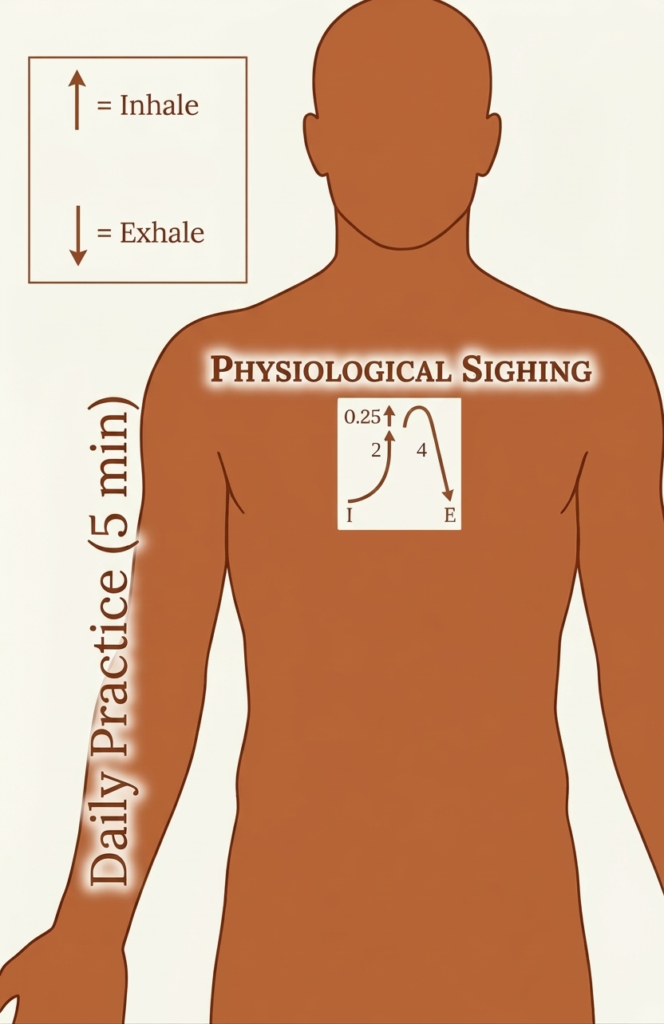
The physiological sigh mirrors a breathing pattern the body already produces spontaneously every few minutes. Its deep double inhale is thought to help reopen the tiny air sacs in the lungs (alveoli) that gradually deflate during normal breathing (Severs et al., 2022). Meanwhile, the extended exhale is most closely linked with calming. Heart rate naturally slows slightly with each out-breath and quickens with each in-breath, so lengthening the exhale is thought to shift this rhythm toward slowing. Practised deliberately, the physiological sigh draws on a process the body already uses to settle itself.
What the research suggests
Balban et al. (2023) conducted a one-month randomised controlled study comparing three different daily five-minute breathwork exercises with an equivalent period of mindfulness meditation. Both approaches improved positive mood and reduced anxiety, but breathwork produced greater benefits for mood and physiological arousal. Cyclic sighing (the physiological sigh) was the most effective of the three breathing techniques tested. Breathwork also lowered resting respiratory rate, and participants’ high adherence to the brief daily protocol suggests that short, high-leverage breathing habits may be a practical, sustainable approach to stress management.
Why practise when calm?
Practising in a calm, low-stress state gives the brain the best chance to learn the breathing sequence. Under acute stress, the brain’s alarm system is thought to take priority over clear, considered thinking, which is why new skills are difficult to learn in the moment. Rehearsing the technique when calm may make it easier to access automatically when frustration or anxiety arises.
“You don’t build a new mind–body pathway while the alarm is sounding. You practise in calm moments so your brain can follow it automatically under pressure.”
Over time, regular practice may also strengthen the brain’s regulation of autonomic responses, improve heart-rate variability (HRV, a marker of baseline vagal regulation) and reduce reactivity to stress. HRV is the natural beat-to-beat variation in your heart rate, and it tends to be greater when the body is relaxed and adaptable.
How to practise the physiological sigh
- Practise for 5 minutes, twice a day: in bed as you lie down for the evening, and when you wake, before you get out of bed.
- Lie on your back with your hands resting on your belly (or beside you if that is more comfortable).
- Inhale deeply through your nose.
- Take a second, shorter nasal inhale to “top up” the breath.
- Exhale slowly and fully through your mouth, letting the out-breath last noticeably longer than the two inhales combined. It can be soft and audible, like a sigh of relief.
- Continue this pattern at a comfortable pace for the full 5 minutes.
The extended exhale may help reduce physiological arousal and support a shift toward calm.
What to expect: The shift is often subtle rather than dramatic, and it tends to build with regular practice. In the Balban et al. (2023) study, the benefits appeared to grow over the month, so consistency matters more than getting it perfect.
If it doesn’t feel right: If you feel light-headed or dizzy, pause and return to your natural breathing. When focusing on your breath makes you feel more anxious, try keeping your eyes open, or resting a hand on something solid like the bed or the floor to stay anchored in the room. If you have a respiratory condition, check with your health practitioner before starting a new breathing practice.
Beyond the physiological sigh: gentle somatic practices
The following gentle somatic practices may also help your body relax when you sense resistance.
1. Befriend the sensation
When nothing is changing, the mind may interpret stillness as a dangerous void. The first step is to stop treating resistance as an enemy that must be defeated.
Rather than asking why nothing is changing, ask:
Where do I feel this struggle in my body right now?
You may notice:
- A tight band across your chest
- A clenched jaw
- A knot in your stomach
- Heaviness in your shoulders
Bring your attention to the sensation’s temperature, texture, shape and boundaries. Try observing it without attempting to fix or dissolve it.
The mind’s struggle may soften when the body feels acknowledged rather than rushed.
2. Use intentional tension and release

Telling a braced muscle to “relax” can create more internal friction. Instead, gently exaggerate the bracing pattern before releasing it.
- If your shoulders are raised or your fists are clenched, deliberately increase the tension for a few seconds.
- Notice the effort required to maintain it.
- Release the contraction with a heavy sigh.
- Let gravity draw your weight downward.
Intentionally contracting and releasing the muscles may help the body move through its stress response and experience the contrast between tension and ease.
3. Lower the stakes
A quiet panic often fuels resistance:
“If nothing is happening now, what if nothing ever happens? What if I am stuck here forever?”
The nervous system may struggle with an imagined future of endless stagnation, but it tends to respond more readily to the immediate present.
Try narrowing your focus to the next ten seconds:
- Release any demand for transformation.
- Attend only to this breath and this moment.
- Give yourself permission to stop pushing temporarily.
This does not mean abandoning your desires or accepting that circumstances must remain unchanged. It means meeting the reality of this moment without fighting it.
You might quietly tell yourself:
“For the next minute, I am allowed to stop pushing.”
4. Return to the physiological sigh
When frustration or resistance spikes, use the breathing pattern you have been practising:
- Inhale deeply through your nose.
- Take a second, shorter nasal inhale to “top up” the breath.
- Exhale slowly and fully through your mouth.
- Repeat once or twice if it feels comfortable.
In the moment, even one to three rounds may be enough to help your breath settle.
A gentle closing
When nothing seems to be moving, your body may be asking for rest rather than another strategy.
You do not need to force yourself into surrender. Softening your grip by even one percent may be enough to let your breath settle a little lower.
Another somatic strategy is TRE® (Tension and Trauma Releasing Exercises). TRE is a gentle technique designed to activate the body’s natural shaking or trembling response, and it may be another supportive option when tension feels stuck. You may find my post Understanding TRE®: a gentle, body-led approach to releasing tension helpful to explore this further.
If some of this feels familiar, or you would like support working with tension and resistance in your body, I’d love to help. You can book a somatic therapy session with me at Treeality Health and Wellbeing.
References
Balban, M. Y., Neri, E., Kogon, M. M., Weed, L., Nouriani, B., Jo, B., Holl, G., Zeitzer, J. M., Spiegel, D., & Huberman, A. D. (2023). Brief structured respiration practices enhance mood and reduce physiological arousal. Cell Reports Medicine, 4(1), Article 100895. https://doi.org/10.1016/j.xcrm.2022.100895
Severs, L. J., Vlemincx, E., & Ramirez, J.-M. (2022). The psychophysiology of the sigh: I: The sigh from the physiological perspective. Biological Psychology, 170, Article 108313. https://doi.org/10.1016/j.biopsycho.2022.108313
Vlemincx, E., Severs, L. J., & Ramirez, J.-M. (2022). The psychophysiology of the sigh: II: The sigh from the psychological perspective. Biological Psychology, 173, Article 108386. https://doi.org/10.1016/j.biopsycho.2022.108386