
Every action in the human body, from a heartbeat to a thought, relies on the movement of proteins. That’s why protein deficiency, even a mild, long-term one, can show up in so many different ways.
As cell biologist Bruce Lipton, Ph.D. explains in The Biology of Belief (Lipton, 2015), proteins are not only the physical building blocks of the cell; their movement is also triggered by signals from the cell’s environment.
Integral Membrane Proteins (IMPs) act as the cell’s antennae and switches. They receive signals from hormones (like insulin) and brain chemical messengers (neurotransmitters), and act as gateways for nutrients (like glucose), allowing the cell to adapt and thrive in its environment. Membrane proteins are so central to how our cells communicate that one family of membrane receptors alone is targeted by around a third of all approved medicines (Santos et al., 2017).
Lipton goes as far as describing the cell membrane as the cell’s true “brain”, rather than the nucleus. Not every biologist agrees with him, and many still see the nucleus and its DNA as the control centre. But whichever part of the cell you see as being in charge, the work itself is largely carried out by proteins: proteins read and copy our DNA, proteins sit in the membrane sensing the outside world, and proteins (as enzymes) drive almost every chemical reaction in the cell.
The key takeaway is: If proteins are the structural “switches” and functional machinery of life, our body requires a constant supply of their fundamental building blocks, ‘amino acids’, to continuously build, repair, and maintain these cellular mechanisms.
Signs of protein deficiency to look out for
Here is a little bit of a guide as to signs that your cells may not be receiving an adequate supply of raw materials to keep their protein machinery running.
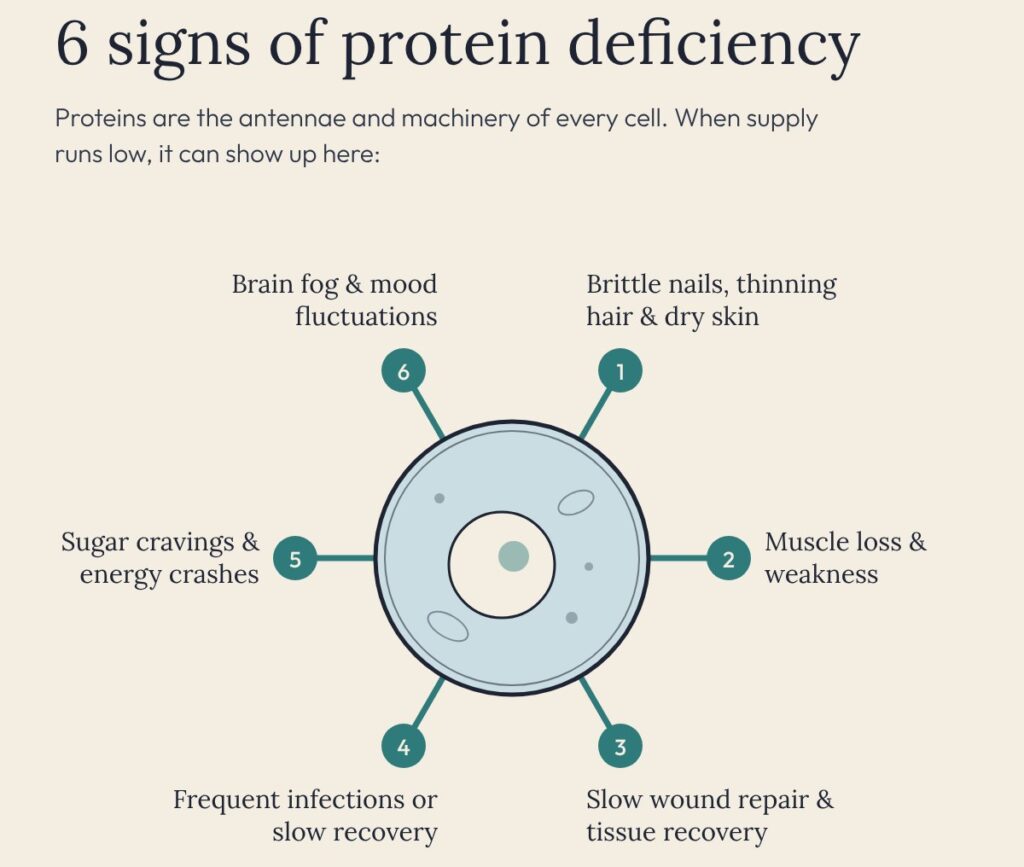
When dietary protein is chronically low, or when digestion/absorption is sub-optimal, long-term protein deficiency can show up as a gradual decline across multiple body systems. Here are some common ones:
Brittle nails, thinning hair & dry skin
- Structural proteins like keratin, collagen, and elastin are put on the back burner when amino acid supplies are scarce. This may show up as slow hair growth, hair shedding, ridged or brittle nails, and loss of skin elasticity (Guo & Katta, 2017).
Muscle loss & weakness
- When amino acids aren’t available from food, the body can break down muscle tissue to supply essential amino acids to high-priority organs like the heart and brain (Wu, 2016).
Slow wound repair & tissue recovery
- Tissue repair depends on making new collagen and new cells. Without adequate amino acids, cuts, bruises, and soft tissue injuries may take longer to repair (Stechmiller, 2010).
Frequent infections or slow recovery from illness
- Antibodies and the immune system’s chemical messengers are made from protein. Inadequate protein intake may weaken immune defences and make you more prone to infections (Li et al., 2007).
Persistent sugar cravings & energy crashes
- Protein is thought to slow the release of sugar into the blood and support the hormones that help you feel full, such as peptide YY and GLP-1 (Batterham et al., 2006). Without enough protein, blood sugar may rise and fall quickly, triggering cravings for sugary or starchy foods. I explore this more in my post Grounded wisdom: unpacking emotional eating, stress & blood sugar.
Brain fog & mood fluctuations
- The body uses amino acids such as tryptophan, tyrosine, and glutamine to make brain chemical messengers (neurotransmitters) including serotonin, dopamine, and GABA. An inadequate supply may affect mood, focus, and mental clarity (Jenkins et al., 2016).
Nourishing your cellular landscape
It’s important to make sure your protein intake is adequate, and also that your digestive system is absorbing protein efficiently.
The digestion factor
We are not what we eat, but what we digest and absorb. Enough stomach acid and digestive enzymes from the pancreas are crucial for breaking complex proteins down into usable amino acids that can be rebuilt into proteins like IMPs.
Medications, health conditions, and physiological factors may interfere with protein digestion and amino acid absorption. Common contributors include:
- Medications that reduce stomach acid production, such as proton pump inhibitors (PPIs, commonly prescribed for reflux) (Evenepoel et al., 1998)
- Long-term use of antacids
- Regular use of NSAIDs, such as ibuprofen (Bjarnason et al., 2018), or chemotherapy drugs
- The pancreas not producing enough digestive enzymes
- Reduced absorption in the gut caused by conditions such as inflammatory bowel disease (IBD) or small intestinal bacterial overgrowth (SIBO)
- Ongoing inflammation in the body, or long-term stress
- Ageing, as appetite often declines and conditions that lower stomach acid become more common
If you take any of these medications, please don’t stop or change them without first speaking with your prescribing doctor.
How much protein do we need?
In Australia, the recommended daily intake for adults aged 19–70 is 0.75 g of protein per kilogram of body weight for women (about 46 g a day) and 0.84 g/kg for men (about 64 g a day). After 70, this rises to 0.94 g/kg for women and 1.07 g/kg for men (National Health and Medical Research Council, 2006). An international expert group has suggested that many older adults may benefit from 1.0–1.2 g/kg to help maintain muscle (Bauer et al., 2013).
How we spread protein across the day may matter too. One study found that eating protein evenly across breakfast, lunch and dinner (around 30 g each) supported muscle protein building more than eating most of it at dinner (Mamerow et al., 2014), which is a good reason to start the day with a protein-rich breakfast.
Who may need to pay closer attention?
- Older adults, as muscle mass naturally declines with age
- People eating plant-based diets, who can meet their needs by combining a variety of plant proteins such as legumes, tofu, nuts, seeds and wholegrains (Hertzler et al., 2020)
- People using GLP-1 weight-loss medications, where eating less overall can make adequate protein harder to reach (Mozaffarian et al., 2025)
- Anyone recovering from surgery, injury or illness, and during pregnancy and breastfeeding
When we break down protein, our kidneys filter out the waste products. In people whose kidneys aren’t working as well, eating more protein may add to that workload. Kidney guidelines generally suggest a moderate, not high, intake for people with chronic kidney disease (Kidney Disease: Improving Global Outcomes [KDIGO], 2024). Protein needs can change a lot depending on the stage of kidney disease and its treatment, so if you have kidney disease, please speak with your GP or specialist before increasing your protein. Kidney Health Australia also has helpful information on eating well with kidney disease.
Morning nourishment: Three simple, satisfying options
I’m not affiliated with any of the brands mentioned here. I simply like them because they have short, simple ingredient lists.
Adequate protein throughout the day is important. These three low-preparation breakfasts help me feel satisfied and ready for the day ahead.
Savoury herb & feta omelette—or tofu scramble (about 15–18 g protein)
- Option A: Fold two free-range eggs with 1 cup baby spinach, fresh chives, and 30 g crumbled goat’s milk feta.
- Option B: Sauté 120 g crumbled firm tofu with 1 cup baby spinach, fresh herbs, a pinch of turmeric, and sea salt.
To make it more substantial: Serve with sautéed mushrooms or one slice of dense sourdough.
Gluten-free Weet-Bix and hemp power bowl (about 25 g protein)
I prefer mine warm, but enjoy it hot or cold.
- 2 gluten-free Weet-Bix
- 1 scoop (about 30 g) Macro organic hemp protein powder
- 1 handful (about 30 g) raw walnuts, chopped
- ½ cup fresh or frozen blueberries and raspberries
- ½ cup (125 mL) almond milk
- 1 teaspoon maple syrup (optional)
Why gluten-free? Gluten-free Weet-Bix are made from wholegrain sorghum, so they’re an easy way to bring a different grain into your week rather than relying on wheat every day. There’s also growing interest in the connection between gut health and skin health, and some people with inflammatory skin conditions such as psoriasis find they feel better reducing gluten (Bhatia et al., 2014). If you suspect gluten is a problem for you, it’s worth getting tested for coeliac disease before cutting it out, as the test relies on gluten still being in your diet.
Morning berry and hemp smoothie (about 22 g protein)
- ¾–1 cup (180–250 mL) almond milk
- ½ frozen banana
- ½ cup frozen blueberries and raspberries
- 1 scoop (about 30 g) Macro organic hemp protein powder
- 1 tablespoon Pic’s crunchy peanut butter
Quick freezer tip for busy mornings
When blueberries and raspberries are affordable, I buy extra and freeze them for times when fresh berries cost more. I also freeze bananas once they become too ripe for eating fresh. They add a frosty texture to smoothies and bowls while saving time, money, and food waste.
A little support along the way
If some of these signs sound familiar, or you’d like help working out whether your body is getting, digesting and absorbing the protein it needs, I’d love to support you. You can book a consultation with me at Treeality Health and Wellbeing.
References
Curious about how I choose and read the research behind my articles? You might enjoy my post Before you trust “The research says…”.
Batterham, R. L., Heffron, H., Kapoor, S., Chivers, J. E., Chandarana, K., Herzog, H., Le Roux, C. W., Thomas, E. L., Bell, J. D., & Withers, D. J. (2006). Critical role for peptide YY in protein-mediated satiation and body-weight regulation. Cell Metabolism, 4(3), 223–233.
Bauer, J., Biolo, G., Cederholm, T., Cesari, M., Cruz-Jentoft, A. J., Morley, J. E., Phillips, S., Sieber, C., Stehle, P., Teta, D., Visvanathan, R., Volpi, E., & Boirie, Y. (2013). Evidence-based recommendations for optimal dietary protein intake in older people: A position paper from the PROT-AGE Study Group. Journal of the American Medical Directors Association, 14(8), 542–559.
Bhatia, B. K., Millsop, J. W., Debbaneh, M., Koo, J., Linos, E., & Liao, W. (2014). Diet and psoriasis, part II: Celiac disease and role of a gluten-free diet. Journal of the American Academy of Dermatology, 71(2), 350–358.
Bjarnason, I., Scarpignato, C., Holmgren, E., Olszewski, M., Rainsford, K. D., & Lanas, A. (2018). Mechanisms of damage to the gastrointestinal tract from nonsteroidal anti-inflammatory drugs. Gastroenterology, 154(3), 500–514.
Evenepoel, P., Claus, D., Geypens, B., Maes, B., Hiele, M., Rutgeerts, P., & Ghoos, Y. (1998). Evidence for impaired assimilation and increased colonic fermentation of protein, related to gastric acid suppression therapy. Alimentary Pharmacology & Therapeutics, 12(10), 1011–1019.
Guo, E. L., & Katta, R. (2017). Diet and hair loss: Effects of nutrient deficiency and supplement use. Dermatology Practical & Conceptual, 7(1), 1–10.
Hertzler, S. R., Lieblein-Boff, J. C., Weiler, M., & Allgeier, C. (2020). Plant proteins: Assessing their nutritional quality and effects on health and physical function. Nutrients, 12(12), 3704.
Jenkins, T. A., Nguyen, J. C. D., Polglaze, K. E., & Bertrand, P. P. (2016). Influence of tryptophan and serotonin on mood and cognition with a possible role of the gut-brain axis. Nutrients, 8(1), 56.
Kidney Disease: Improving Global Outcomes (KDIGO) CKD Work Group. (2024). KDIGO 2024 clinical practice guideline for the evaluation and management of chronic kidney disease. Kidney International, 105(4S), S117–S314.
Li, P., Yin, Y.-L., Li, D., Kim, S. W., & Wu, G. (2007). Amino acids and immune function. British Journal of Nutrition, 98(2), 237–252.
Lipton, B. H. (2015). The biology of belief: Unleashing the power of consciousness, matter & miracles (10th anniversary ed.). Hay House.
Mamerow, M. M., Mettler, J. A., English, K. L., Casperson, S. L., Arentson-Lantz, E., Sheffield-Moore, M., Layman, D. K., & Paddon-Jones, D. (2014). Dietary protein distribution positively influences 24-h muscle protein synthesis in healthy adults. The Journal of Nutrition, 144(6), 876–880.
Mozaffarian, D., Agarwal, M., Aggarwal, M., Alexander, L., Apovian, C. M., Bindlish, S., Bonnet, J., Butsch, W. S., Christensen, S., Gianos, E., Gulati, M., Gupta, A., Horn, D., Kane, R. M., Saluja, J., Sannidhi, D., Stanford, F. C., & Callahan, E. A. (2025). Nutritional priorities to support GLP-1 therapy for obesity: A joint advisory from the American College of Lifestyle Medicine, the American Society for Nutrition, the Obesity Medicine Association, and The Obesity Society. The American Journal of Clinical Nutrition, 122, 344–367. https://doi.org/10.1016/j.ajcnut.2025.04.023
National Health and Medical Research Council. (2006). Nutrient reference values for Australia and New Zealand: Protein. Australian Government. https://www.eatforhealth.gov.au/nutrient-reference-values/nutrients/protein
Santos, R., Ursu, O., Gaulton, A., Bento, A. P., Donadi, R. S., Bologa, C. G., Karlsson, A., Al-Lazikani, B., Hersey, J., Oprea, T. I., & Overington, J. P. (2017). A comprehensive map of molecular drug targets. Nature Reviews Drug Discovery, 16(1), 19–34.
Stechmiller, J. K. (2010). Understanding the role of nutrition and wound healing. Nutrition in Clinical Practice, 25(1), 61–68.
Wu, G. (2016). Dietary protein intake and human health. Food & Function, 7(3), 1251–1265.